
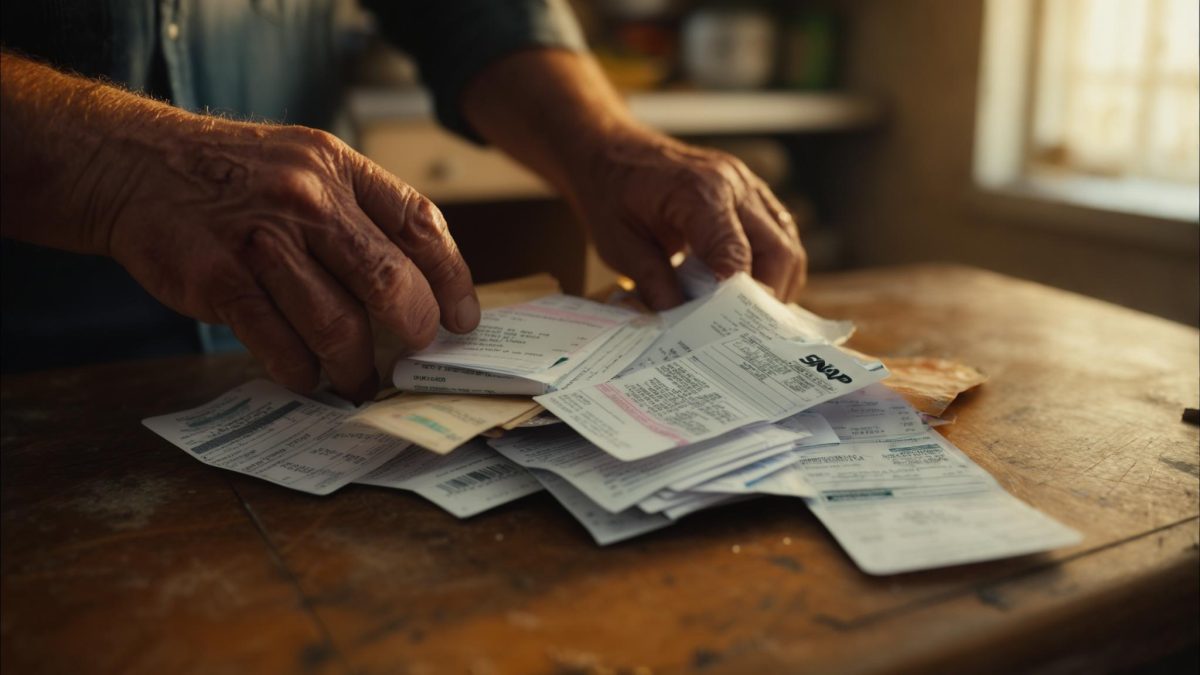
The conventional wisdom about government food assistance is that it exists as a last resort — something families reach for only after every other option collapses. But after spending an afternoon with Reggie Chen-Ramirez in a quiet booth at a diner near his apartment in Omaha, Nebraska, I came away convinced that framing gets it exactly backward. For families like his, SNAP isn’t a last resort. It’s often the only thing still standing after the last resort has already failed.
I first encountered Reggie in March 2026, entirely by chance. I was filling up at a Shell station off South 72nd Street when I heard the man ahead of me at the next pump saying, with a patience that sounded rehearsed, “I can’t give you an average — I don’t have an average. The money comes in when it comes in.” He was on the phone with what I later learned was the Nebraska Department of Health and Human Services, trying to document his income for a SNAP recertification review. I waited until he hung up, introduced myself, and handed him my card. He called two days later.
A Freelancer’s Income on Paper Looks Like a Crisis Every Month
Reggie Chen-Ramirez is 39 years old, married, and has a 17-year-old heading to college in the fall of 2026. He has worked as a freelance graphic designer for eleven years, building a client base that includes small businesses, a regional ad agency, and a handful of nonprofits. On paper, his annual income has ranged between $28,000 and $44,000 depending on the year. On any given month, though, it could be $900 or it could be $4,200.
“I’ve explained to so many people that freelance doesn’t mean I get a check every two weeks,” Reggie told me, stirring his coffee without drinking it. “It means sometimes a client pays late, sometimes a project falls through, and sometimes February is $1,100 and March is $3,600. Nobody in a government office knows what to do with that.”
According to the USDA Food and Nutrition Service, SNAP eligibility is calculated using gross and net monthly income against the federal poverty level. For a household of three in 2025, the gross income limit sat at approximately $2,311 per month — 130% of the poverty line. The problem for Reggie is that some months he clears that threshold by $1,400. Others, he misses it by $600. The program is designed around predictability that freelance life simply does not provide.
The Co-Signed Loan That Took Everything Except the Debt
The income volatility alone would have been manageable — barely, but manageable. What tipped the balance was a decision Reggie made in early 2023, when his younger brother asked him to co-sign a $9,200 auto loan. The brother had a thin credit file and needed the car to get to a new job. Reggie agreed.
By August 2023, the brother had stopped making payments. By November, the loan was 90 days delinquent. The lender repossessed the vehicle in January 2024 and pursued the deficiency balance — roughly $6,400 after auction — against Reggie as the co-signer. His credit score, which had been around 671, dropped to 514 within three months.
“I knew it was a risk,” Reggie said quietly. “I didn’t know it would follow me like this. Every time I try to do something — refinance, get a credit card for work expenses, even rent a moving truck — it’s there. It’s just there.”
The credit damage compounded other problems. When Reggie’s lease came up for renewal in March 2025, his landlord raised the rent from $1,040 to $1,352 per month — a 30% increase. Because his credit score was now below 580, he had almost no leverage to negotiate or realistically qualify for a different unit without a substantial deposit he couldn’t pull together. He signed the new lease.
When the Numbers Finally Forced the Question
It was his wife, Deja, who first said the word out loud. SNAP. Reggie told me he resisted the idea for months — not out of pride exactly, but out of a belief that the system wouldn’t work for someone whose income looked the way his did. He’d heard too many stories about people getting approved, then disqualified the next month because one invoice came in and pushed them over the threshold.
The family finally applied in July 2025. Their combined monthly expenses by that point included $1,352 in rent, roughly $480 in utilities, $220 in minimum debt payments tied to the co-signed loan deficiency judgment, and health insurance premiums through the Nebraska ACA marketplace of approximately $317 per month after their tax credit subsidy. Groceries for three people — including a teenager who, as Reggie put it, “eats like a small construction crew” — ran between $680 and $820 monthly.
The Application Process Was Its Own Obstacle Course
Reggie applied online through Nebraska’s ACCESSNebraska portal in July 2025. The application itself took about an hour. What came next took considerably longer.
The state requested three months of bank statements, a client invoice log, documentation of his business expenses, and a self-employment worksheet. Because Reggie’s income had varied between $1,150 and $3,820 in the preceding three months, the caseworker needed to calculate an “average” — a process Reggie described as feeling fundamentally disconnected from how his work actually functions.
After a phone interview in August 2025 and an additional two-week delay tied to the income averaging calculation, the family was approved in September 2025. Their benefit was set at $412 per month — well below the household maximum of $766, because the averaged income still pushed their net figure above the threshold for a full benefit. Reggie told me the number felt both like relief and like a reminder of how close to the line they were living.
Six Months In, the Math Is Still Uncertain
When I spoke with Reggie in late March 2026, the family had received SNAP benefits for six months. The $412 monthly benefit had helped — meaningfully, he said — but it hadn’t resolved the underlying fragility. The co-signed loan judgment was still on his credit report and wouldn’t age off until 2030 under standard credit reporting timelines. The rent was still $1,352. His teenager had been accepted to the University of Nebraska-Lincoln and was evaluating financial aid packages that Reggie hoped would require minimal parental contribution given their income situation.
“I’m not complaining,” Reggie said, and he meant it — there was no self-pity in how he said it. “I’m just tired. Tired of every month being a puzzle. Tired of not knowing if we’ll qualify again at recertification because I had a good run of invoices.”
His upcoming recertification is scheduled for April 2026 — the same month I’m writing this. He pulled in $3,950 in March from a larger-than-usual corporate identity project. He doesn’t know yet what that will mean for his benefit. He described the feeling as waiting for a verdict on something you didn’t actually do wrong.
What lingers after my conversation with Reggie isn’t a cautionary tale or a success story — it’s something more complicated. He did several things that, in retrospect, he wishes he hadn’t: co-signing for a family member without a backup plan, staying in an apartment where the landlord clearly intended to raise rents aggressively, keeping his income structure entirely variable without a financial cushion. But none of those decisions were reckless. They were the decisions of someone operating with limited options, making reasonable bets that didn’t pay off.
According to the Center on Budget and Policy Priorities, roughly 42% of SNAP households include at least one working adult — the program is not, as it is sometimes characterized, reserved for people who are not working. Reggie is working. He’s working constantly. The system just wasn’t built with his kind of work in mind.
Before I left, I asked Reggie what he wanted people to understand about his situation. He thought about it for a moment, then said: “That we’re not a story about bad decisions. We’re a story about how fast things can stack up when you don’t have anything to absorb the hit.” He picked up his coffee, finally drank some of it, and looked out the window at the parking lot. There was nothing dramatic about the moment. It was just a Tuesday in Omaha, and a man who was tired was trying to figure out what April looked like.




Leave a Reply