
Have you ever done the math on what it would cost you to stay healthy for one more month — and come up short? That question sat with me long after I finished talking to Sylvia Santiago on a Tuesday afternoon in late March 2026, in a small conference room at the Tennessee Valley Federal Credit Union branch off Kingston Pike in Knoxville.
I wasn’t looking for Sylvia. A branch manager named Darlene, who had watched Sylvia come in twice in one week asking about hardship withdrawal options, suggested I reach out. “She’s not reckless,” Darlene told me. “She’s just getting squeezed from every direction at once.” Sylvia agreed to talk. She brought a manila folder full of explanation-of-benefits statements and a highlighter.
A Budget Built on Careful Math That Suddenly Stopped Adding Up
Sylvia Santiago is 37 years old. She teaches yoga part-time at two studios in Knoxville — one downtown, one in the Bearden neighborhood — and earns roughly $38,000 a year. She has a 15-year-old daughter named Marisol, and she has been raising her alone since a separation in 2019 left her without reliable child support. She describes herself as someone who “obsesses over spreadsheets,” and I believed her the moment she laid out her folder.
For most of 2025, Sylvia’s monthly budget looked like this: rent at $1,140, groceries around $320, utilities averaging $95, and two prescription medications — one for hypothyroidism, one for generalized anxiety — totaling $45 a month under her employer-sponsored insurance plan. She had built that budget carefully over three years, cell by cell.
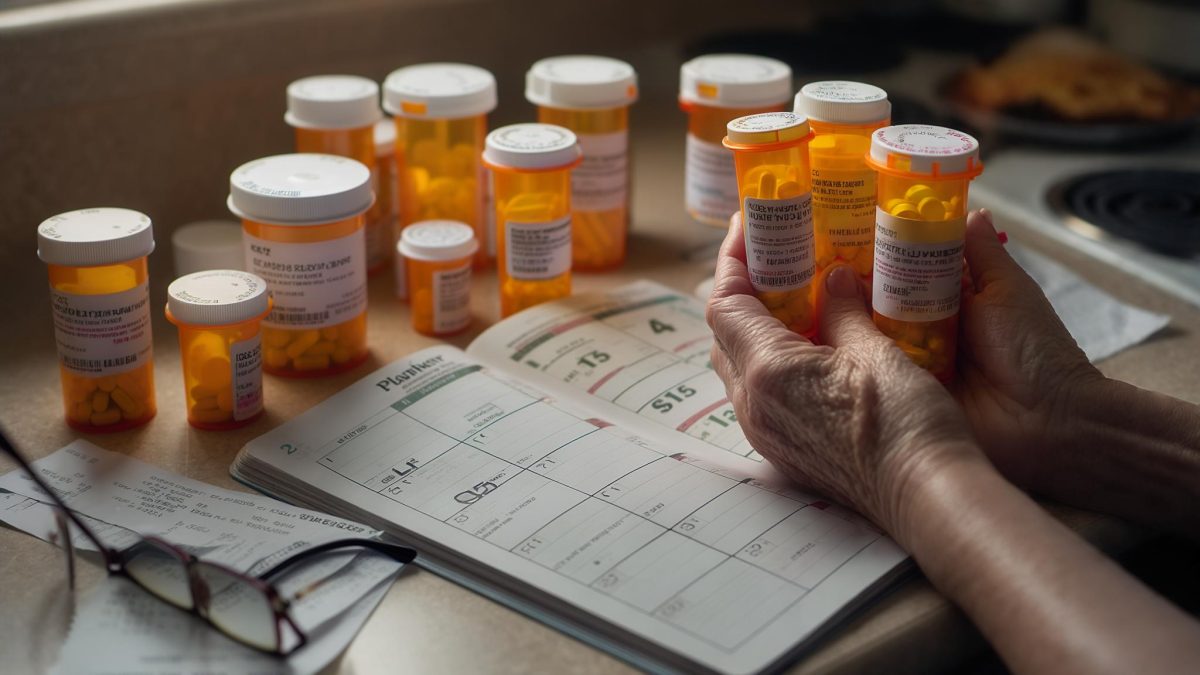
In January 2026, one of the studios switched its group health plan to a higher-deductible option with a different pharmacy formulary. Sylvia’s levothyroxine — a generic thyroid medication she had taken for six years — moved from Tier 1 to Tier 3 on the new plan’s drug list. Her anxiety medication was no longer covered at all until she met a $1,500 deductible. Her monthly prescription bill jumped to $187 almost overnight.
The Backstory: A Credit Score Haunted by Medical Debt
What made January’s prescription crisis so difficult wasn’t just the number. It was that Sylvia had almost no financial cushion left to absorb it. That cushion had been slowly eroded since 2022, when Marisol was hospitalized briefly for a broken arm that required surgery. The bill, after insurance, came to $3,200. Sylvia put $900 on a credit card and made an agreement to pay the remaining $2,300 directly to the hospital in installments.
She missed two payments during a period when one studio cut her hours. The account went to collections in early 2023. By the time she paid off the balance in full in August of that year, the damage was done. When I spoke with Sylvia, her credit score sat at approximately 594 — a number she described, quietly, as “a daily reminder of something I can’t stop punishing myself for.”
The low credit score mattered practically, not just emotionally. When Sylvia looked into consolidating a small personal loan she had taken out in 2024 to cover a car repair, she was quoted an interest rate of 22.9 percent — a rate that made the consolidation pointless. The credit union visit that led me to her was Sylvia’s attempt to find out whether a hardship withdrawal from her small retirement account might be a better option.
The Retirement Account She Fears Touching
Sylvia has approximately $12,400 in a SIMPLE IRA she opened through one of the studios in 2021. She contributes $80 a month when she can, and she skips contributions in months when she cannot. At 37, with Marisol heading toward college in roughly three years, she told me she thinks about retirement savings the way someone thinks about a slow leak in a roof — she knows it needs attention, and she keeps deferring it anyway.
When Sylvia asked the credit union about a hardship withdrawal, Darlene walked her through the math. Because Sylvia’s SIMPLE IRA was opened in 2021, the two-year waiting period for standard 10 percent penalty rules had passed — she would face the regular 10 percent penalty plus income tax on any amount withdrawn, not the steeper 25 percent. But on a $5,000 withdrawal, she would still likely owe somewhere between $1,200 and $1,700 total between taxes and the penalty, depending on her effective rate for the year.
What Changed — and What Didn’t
Sylvia did not make a hardship withdrawal. In February 2026, she found two alternatives that together brought her monthly prescription costs down to approximately $67 — still higher than before, but manageable. The first was a manufacturer patient assistance program for her anxiety medication, which she applied for online and was approved for within 11 days. The second was a switch to a different generic formulation of her thyroid medication, confirmed as bioequivalent by her physician, that her pharmacist found covered at Tier 1 under the new plan.
The retirement account question, however, remains open. Sylvia told me she still contributes when she can but skipped March’s $80 contribution to cover a dental bill for Marisol. She knows the math on compounding. She cited it to me, unprompted, with the quiet frustration of someone who understands a concept perfectly and still cannot fully act on it.
Her credit score has ticked upward — she said a recent check showed 611 — partly because the collection entry from 2023 is now over three years old and carrying less weight. She has not opened any new credit lines. She uses one secured card with a $500 limit, pays it in full monthly, and checks her report every 90 days through AnnualCreditReport.com.
The Worry That Has No Easy Resolution
Of all the things Sylvia and I discussed, the one she returned to most was a fear she couldn’t fully quantify: running out of money in old age. With $12,400 saved at 37, no employer pension, and a part-time income that offers no guarantee of continuity as her body ages in a physically demanding profession, she describes retirement as “a math problem I keep starting and never finishing.”
She asked me, at one point, what Social Security would look like for someone with her work history. I told her I couldn’t give her projections, but that the Social Security Administration’s my Social Security portal allows workers to view estimated future benefits based on actual earnings records. She wrote that down. She said no one had told her that before.
When I left Sylvia at the credit union that afternoon, she was putting her folder back together — EOB statements, pharmacy receipts, the handwritten note she’d made about the SSA portal. There was no triumphant resolution to report. Her prescriptions are affordable again, for now. Her retirement account is intact, for now. Her credit score is slowly climbing, one on-time payment at a time.
What struck me most about Sylvia wasn’t the numbers — it was how clearly she understood them, and how little that understanding had protected her. She knew her formulary tiers. She knew her deductible reset date. She knew the IRS penalty structure on her retirement account. None of that knowledge prevented January from happening. It just meant she could describe the fall in precise detail.
That gap between knowing and being okay is where a lot of people are quietly living. Sylvia Santiago is one of them, and she agreed to let me tell you so.




Leave a Reply