

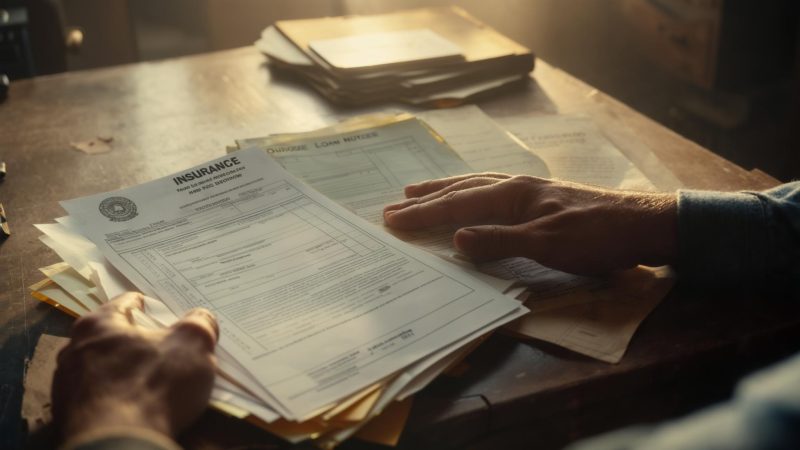
The envelope sat on Dianne Velasquez’s kitchen counter for three days before she opened it. She told me she already knew, somehow, that it was going to be bad. “I just kept walking past it,” she said. “Like if I didn’t open it, it wasn’t real.”
It was real. The letter from the IRS, dated January 9, 2025, informed her that she owed $8,412 in back taxes, penalties, and interest — money tied to joint returns she had filed with her ex-husband during their marriage. She hadn’t known he was hiding anything. She hadn’t known there was anything to hide.
I connected with Dianne through a Phoenix-area financial counselor who had been working with her since the spring of 2025. The counselor reached out to me directly, saying she had a client whose story “needed to be told” — not as a cautionary tale, but as an honest account of how financial deception inside a marriage can follow you long after the divorce papers are signed. Dianne agreed to speak with me over two sessions in late March 2026, at a coffee shop near her apartment in central Phoenix.
A Marriage That Looked Fine on Paper
Dianne and her ex-husband, Marcus, married in 2018. She was 26, working her way up in marketing at a mid-size agency. He was a project manager at a construction firm, and on the surface, their finances looked manageable. They filed joint tax returns every year. She assumed he handled the details accurately.
What she didn’t know was that Marcus had been running a freelance consulting operation on the side — clients he brought in quietly, income he received in cash transfers and Venmo payments. According to Dianne, he never mentioned it. “He told me he was doing a little extra work sometimes, but I thought he meant overtime,” she said. “I had no idea he was bringing in real money and just… not reporting it.”
Over the 2019, 2020, and 2021 tax years, the IRS determined that Marcus had received approximately $31,000 in unreported self-employment income. The agency had begun cross-referencing payment platform data more aggressively in 2023 and 2024, and Marcus’s side income eventually surfaced during a compliance audit. By then, the couple had been divorced for nearly two years.
Dianne’s name was on all three joint returns. Under federal tax law, that made her jointly and severally liable for the balance. The divorce decree — which she had paid $2,200 in legal fees to finalize — said nothing about tax liability, because nobody knew there was any.
The Moment the Floor Dropped Out
When I asked Dianne to describe reading the IRS letter for the first time, she paused for a long moment. “I felt stupid,” she said quietly. “Even though I know I didn’t do anything wrong. I still felt like an idiot for not knowing.”
She was earning approximately $54,000 a year as a marketing manager at a Phoenix-based tech startup — but the income was uneven. Her base salary was $42,000, with performance bonuses that ranged from nothing to $12,000 in a good quarter. She also paid $820 per month in child support for her two children, ages 7 and 9, who lived primarily with Marcus.
She had roughly $1,100 in savings when the notice arrived. The IRS was asking for full payment within 30 days or a response initiating a payment arrangement. She had never dealt with the IRS directly before. She didn’t know what “CP2000” meant on the top of the letter. She Googled it at 11 p.m. on a Tuesday and, by her own account, did not sleep that night.
“I kept reading threads on Reddit trying to figure out if I was going to be arrested or something,” she told me, laughing slightly at herself. “I know that sounds dramatic. But I genuinely did not know what happened to people in this situation.”
Learning About Innocent Spouse Relief — After the Damage Was Done
The financial counselor Dianne eventually found — through a nonprofit credit counseling agency — was the one who first told her that the IRS has a formal program called Innocent Spouse Relief. Under this provision, a spouse who was unaware of errors or underreporting on a joint return may be able to request separation of liability or equitable relief.
According to the Social Security Act §202 framework and parallel IRS provisions, the burden of proof matters enormously in these cases. Dianne had no documentation showing Marcus had kept financial matters from her — no emails, no bank statements she’d been locked out of, nothing that clearly proved she had been kept in the dark. Her case for innocent spouse relief was possible, her counselor told her, but not guaranteed.
Dianne filed Form 8857 in May 2025, approximately four months after receiving the original notice. The process required her to reconstruct her knowledge of the household finances during the marriage — what accounts she had access to, what she knew about Marcus’s work, what she had signed. She described it as emotionally exhausting.
“It’s not just financial,” she told me. “You have to go back through your whole marriage and explain why you didn’t notice things. It feels like you’re on trial for being naive.”
Where Things Stand — and What It Actually Cost Her
When I met with Dianne in March 2026, the innocent spouse case was still pending. The IRS had acknowledged receipt of her Form 8857, and she had received a letter confirming that collection activity would be paused during the review — a standard procedure. But she had no resolution yet. The $8,412 balance remained on the books.
In the meantime, her irregular income had continued to complicate everything. A strong bonus quarter in late 2025 — roughly $9,000 before taxes — had briefly felt like a lifeline, but she had used most of it to cover overdue bills and a $1,400 car repair. Her savings were back below $1,500. She was budgeting week to week, not month to month.
“Some months I feel like I’m actually getting ahead,” she told me. “Then there’s a month with no bonus and I’m eating pasta four nights a week. There’s no baseline. There’s no floor.”
The math, as she laid it out, leaves approximately $685 a month for utilities, phone, clothing, medical copays, and any unexpected expense. There is no buffer. The IRS situation sits on top of all of it like a weight she cannot yet put down.
The Harder Question She’s Still Sitting With
Before we wrapped up our second conversation, I asked Dianne what she wished she had known before signing those joint returns. She thought about it for a while before answering.
She’s not bitter in the way I expected. She’s tired, mostly. She described herself as someone who has always moved fast — made quick decisions, trusted her instincts, spent impulsively when things were good and panicked when they weren’t. The IRS situation had forced something slower on her: weeks of paperwork, documentation, waiting.
“This has been the most administrative experience of my life,” she said, smiling slightly. “And I mean that in a bad way.”
There’s no tidy resolution here yet. The innocent spouse case could go either way, according to the counselor who connected us. If it’s denied, Dianne will face the full $8,412 balance and will need to negotiate a payment plan with the IRS — the agency does allow installment arrangements, and per SSA overpayment guidance, similar income-based repayment frameworks exist across federal agencies that may inform how she approaches the negotiation. But that process carries its own costs and consequences.
What stays with me from our conversations is something Dianne said almost as an aside, near the end of the second session. She had just described a recent weekend where her kids visited, and how she’d taken them to a free outdoor festival downtown because it was all she could swing. “They didn’t know,” she said. “They just thought it was fun. And it was fun.” She paused. “I just need all of this to be over so I can actually enjoy it with them.”
That’s where she is — not broken, not fixed. Just waiting, and trying to hold things together in the meantime.
Related: He Runs a Daycare, Supports His Aging Parent, and Then His Parent’s Medicare Supplement Bill Jumped 20%
Related: A Fresno Plumber Lost $8,300 in Overtime and Couldn’t Fix Her Roof — Then a Social Worker Pointed Her Toward Federal Relief She Didn’t Know Existed



Leave a Reply