

The personal finance world loves a clean rule: build your emergency fund first, then invest, then buy a home. Kevin Andersen did everything right — and the rules still left him stuck, staring at a spreadsheet at midnight with his wife four months from her due date and no clear answer in sight.
I met Kevin Andersen, 36, in late February 2026 at a coffee shop near his home in Minneapolis. He’s a union journeyman electrician — practical, deliberate, the kind of person who reads The Total Money Makeover and then immediately questions whether Dave Ramsey has ever competed with a cash offer in a Twin Cities real estate market. He came with a printed spreadsheet. He left with more questions than answers, and he said that was actually progress.
A Disciplined Saver Who Started Too Late
By almost any measure, Kevin and his wife Jenna are doing the right things. He earns roughly $72,000 annually through his union, and Jenna, a dental hygienist, brings in approximately $33,000. Together, their $105,000 household income puts them comfortably above the Minneapolis metro median. They max out their HSA each year — $8,300 for a family in 2026, according to the IRS — and Kevin contributes to his union pension.
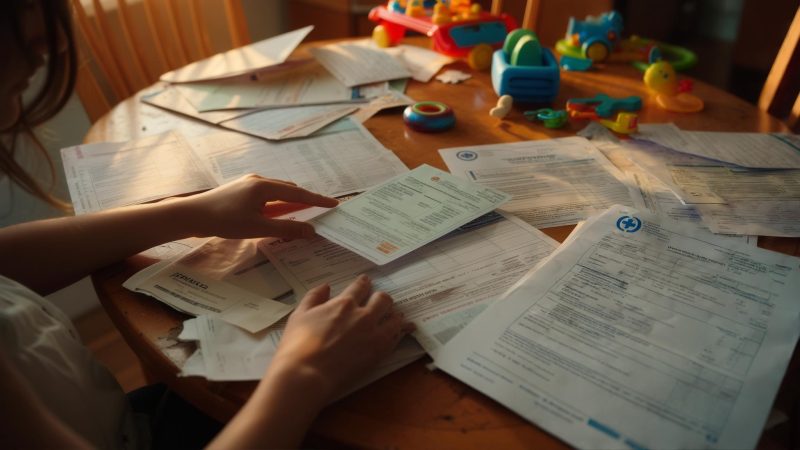
But they didn’t start aggressively saving until Kevin was 33. Three years of disciplined effort got them to $22,000 in liquid savings. For most people, that sounds like a win. For Kevin, staring at a spreadsheet that needs two different things from the same pile of money, it feels like a trap.
Kevin told me the paralysis set in around December 2025, when Jenna’s pregnancy became real in the financial sense. She works for a private dental practice that offers no paid maternity leave. Under the Family and Medical Leave Act, she’s entitled to 12 weeks of unpaid, job-protected leave — which means roughly $7,600 in lost income over three months, assuming she takes the full leave period. That’s before the hospital bill, before the new insurance costs of adding a dependent, before the logistics of childcare.
The Numbers That Don’t Add Up
When Kevin walked me through his spreadsheet, the math was genuinely bleak — not catastrophic, but tight in a way that makes every dollar feel load-bearing.
A six-month emergency fund, based on their current monthly expenses of roughly $6,500, would require $39,000. Their $22,000 covers that at about 56 cents on the dollar — which means they’re not even close to the full emergency cushion before the baby arrives. And the house? The median home price in the Minneapolis metro was approximately $395,000–$495,000 in early 2026, depending on neighborhood. A 10% down payment alone exceeds everything they’ve saved.
“We’re not going to hit both goals before July,” Kevin said flatly when I asked him to state the obvious. “So the question is which one we gut, and how badly.”
The House Dream vs. The Safety Net
Kevin and Jenna have been renting a two-bedroom apartment in South Minneapolis for $1,640 a month. They planned to buy before the baby arrived — a goal Kevin described as “not a preference, it felt like a necessity.” He wanted a yard. A garage. A bedroom they didn’t have to convert from a home office.
But Minneapolis’s housing market in early 2026 has been punishing to buyers without significant cash reserves. Kevin told me about three homes they toured last fall where the winning offer was all cash, above asking, with no inspection contingency. Their pre-approval letter and $22,000 simply weren’t competitive.
The comparison Kevin kept returning to was timing. If they prioritize the emergency fund now — padding it toward $30,000 or $32,000 before July — they have a real cushion for the maternity leave period and the baby’s early months. But they lose another year on the housing market, during which their rent continues and home prices may climb further.
If they push aggressively toward a down payment, they enter the housing market thin on reserves — potentially buying a home with $8,000–$10,000 left in savings right before Jenna stops drawing a paycheck for three months. Kevin knows what that risk looks like. He’s seen co-workers get laid off mid-project. He knows what one bad month on a job site can mean.
The Decision — and What It Actually Cost
By the time Kevin and I finished our second round of coffee, he had already made the decision — he just hadn’t said it out loud yet. When I asked him directly which goal he was choosing, he took a long pause.
Kevin told me he and Jenna had reached this conclusion together, but that the housing delay genuinely stings. Their goal had shifted: get the emergency fund to $32,000 before the baby arrives in late June or early July, protect that cushion through the maternity leave period, and resume saving for a down payment once Jenna returns to work. A realistic home purchase timeline, Kevin estimated, is now late 2027 at the earliest.
What Kevin kept circling back to — and what I found most striking — was that none of this felt like failure to him. It felt like the responsible version of disappointment. “I wanted the house before the baby,” he told me near the end of our conversation. “That was the dream. It didn’t work out that way. But the goal was always to be a good provider. And sometimes that means the house waits.”
The childcare math, he acknowledged, hasn’t even fully hit yet. Infant care in Minneapolis averages roughly $1,500–$2,000 per month, according to state-level data tracked by the U.S. Department of Labor. Once Jenna returns to work, that bill lands. Kevin is counting on his union wages to absorb it — but it means the down payment timeline, already delayed, likely pushes further.
What Kevin Would Tell Someone in the Same Position
I asked Kevin, as we were wrapping up, whether he wished he’d started saving earlier — the obvious question, the one every 36-year-old with a late start gets. He didn’t flinch.
He’s not wrong that the conventional sequencing — emergency fund, then debt, then invest, then buy — was designed with a certain luxury of time. For someone at 25, stacking those goals across a decade is realistic. For Kevin at 36, with a baby four months out, the rules compress into an impossible shape, and something has to give.
When I left the coffee shop, Kevin was already back on his phone, pulling up a HYSA comparison. Not paralyzed anymore. Just working the numbers — the same way he would wire a panel, one circuit at a time.



Leave a Reply