
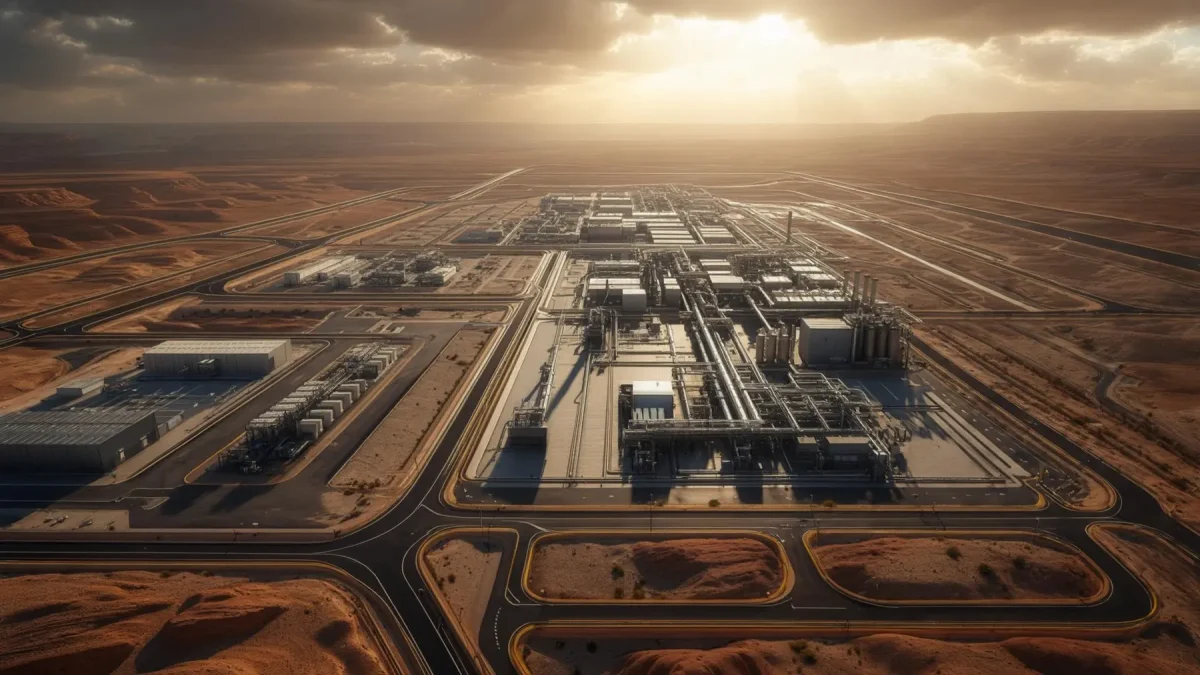
Roughly 180 ballistic missiles were fired at Israel during Iran’s April 2024 attack, but a strike on a chemical industrial zone carries a different order of risk entirely. When an Iranian ballistic missile struck the Ne’ot Hovav industrial complex in Israel’s Negev desert, the immediate military question gave way to a more urgent one: what was inside that factory, and where was it going?
Ne’ot Hovav sits approximately 30 kilometers south of Be’er Sheva, deep in the Negev. It is not a random target. The zone houses some of Israel’s most sensitive chemical manufacturing operations, including facilities linked to the state-owned ICL Group, one of the world’s largest producers of specialty minerals and chemicals.
What Happened at Ne’ot Hovav and Why It Matters
An Iranian ballistic missile struck the Ne’ot Hovav industrial zone in Israel’s Negev region, hitting what multiple sources describe as a chemical complex linked to ICL Group and possibly connected to white phosphorus production. The strike occurred without sufficient warning for full industrial evacuation protocols to activate.
White phosphorus is a highly reactive substance. On contact with air, it ignites spontaneously and burns at approximately 816 degrees Celsius. When used near populated areas or released from a damaged industrial facility, it poses severe risks: respiratory damage, chemical burns, and toxic smoke plumes that travel with wind patterns. A breached storage or production unit does not need a direct explosion to cause casualties; even a structural compromise can release enough material to endanger a wide radius.
Ne’ot Hovav is also home to facilities handling bromine, potash, and other industrial chemicals. The zone has been described by Israeli environmental agencies as one of the country’s most concentrated chemical production areas. A single missile strike in the wrong location could trigger cascading failures across multiple storage units.
| Chemical Present | Primary Risk | Dispersion Range (Estimated) |
|---|---|---|
| White Phosphorus | Spontaneous combustion, toxic smoke | Up to 5 km depending on wind |
| Bromine | Severe respiratory and skin damage | 2–4 km in open terrain |
| Potash compounds | Water contamination if runoff occurs | Groundwater dependent |
| Chlorine derivatives | Pulmonary toxicity | Variable, wind-driven |
How the Strike Fits Iran’s Targeting Strategy
This was not an opportunistic hit. Targeting an industrial chemical zone requires specific intelligence: facility coordinates, production schedules, and knowledge of what secondary effects a strike might produce. Iran’s missile program has grown precise enough to distinguish between military and industrial targets at distances exceeding 1,000 kilometers.
Iranian ballistic missiles like the Fattah-1 and Shahab-3 variants have demonstrated circular error probables (CEPs) of roughly 30–500 meters depending on the variant and guidance package used. Hitting a specific building within an industrial complex, rather than the complex perimeter, suggests either improved guidance or pre-positioned targeting data.
“Striking a chemical plant is a form of environmental warfare. The missile does the kinetic damage; the chemicals do the rest.” — Regional security analyst, cited in post-strike assessments
Experts have noted that targeting civilian industrial infrastructure, particularly chemical plants, represents an escalation beyond conventional military strikes. Under international humanitarian law, attacking facilities containing dangerous forces, including chemical plants, is prohibited when the release of those forces would cause severe civilian losses. Whether this strike meets that threshold is now a matter of active legal and diplomatic debate.
From a strategic standpoint, Iran gains multiple advantages from this type of strike. Direct military damage, potential chemical contamination, civilian panic, and an international media cycle focused on Israeli vulnerability rather than Iranian aggression. I’d argue this multi-layered effect is precisely why chemical zones are attractive targets in asymmetric conflict.
Why Chemical Industrial Zones Are Uniquely Vulnerable
Standard military hardening does not apply to chemical production facilities. You cannot encase bromine storage tanks in reinforced concrete without creating operational impossibilities. Ventilation, access, and pressure management requirements mean these facilities are structurally open in ways that military installations are not.
Ne’ot Hovav’s location in the Negev was historically chosen for its distance from population centers. Be’er Sheva, the nearest major city, sits about 30 kilometers north. Dimona, home to Israel’s nuclear research center, is approximately 35 kilometers to the northeast. That buffer was designed for accidents, not precision missile strikes.
- Wind patterns in the Negev can carry airborne chemical plumes northward toward Be’er Sheva within 20–40 minutes under typical conditions.
- Emergency response teams in the Negev are equipped for industrial accidents but have limited capacity for simultaneous missile strike triage and chemical containment.
- Water sources in the region, including the Negev aquifer system, are vulnerable to runoff contamination if large quantities of industrial chemicals reach the soil.
- ICL Group operates facilities in multiple countries, meaning a disruption at Ne’ot Hovav has supply chain implications well beyond Israel’s borders.
The Broader Implications for Industrial Security in Conflict Zones
Israel is not the only country with chemical industrial zones near potential conflict vectors. This strike sets a precedent that other state and non-state actors will study carefully. If a ballistic missile can be used to trigger a chemical release at a civilian industrial facility, the calculus for infrastructure targeting shifts significantly across multiple conflict theaters.
The political calculus: For Israel specifically, the strike raises immediate questions about the Iron Dome and Arrow missile defense systems. Both systems performed at high interception rates during previous Iranian barrages. A missile that reaches Ne’ot Hovav either penetrated those defenses or was part of a saturation attack designed to overwhelm interception capacity. Either scenario demands a response from Israel’s defense procurement and deployment strategy.
The economic dimension is also significant. ICL Group is publicly traded, with a market capitalization in the billions. Damage to Ne’ot Hovav facilities affects global supply chains for bromine, potash, and specialty phosphates.
Prices for these materials were already elevated due to broader geopolitical disruptions. A prolonged shutdown at Ne’ot Hovav would push costs higher across agricultural, pharmaceutical, and electronics sectors that depend on ICL’s output.
For more on the legal frameworks governing attacks on civilian industrial infrastructure, the International Committee of the Red Cross publishes the full text of Additional Protocol I, which addresses protection of objects containing dangerous forces.
What Comes Next: Defense, Diplomacy, and Industrial Hardening
Three tracks are likely to move simultaneously in the aftermath of this strike. First, Israel’s military will conduct damage assessment and determine whether a kinetic response is warranted, proportionate, and strategically timed. Second, Israeli emergency services and environmental agencies will work to assess contamination levels at and around Ne’ot Hovav, likely imposing exclusion zones and air quality monitoring across the southern Negev.
Third, and perhaps most consequentially over the long term, Israel will face pressure to harden or relocate chemical industrial infrastructure. Hardening is expensive and operationally complex. Relocation is even more so.
ICL’s Ne’ot Hovav operations are deeply integrated into local logistics, water access, and transportation networks built over decades. Moving them is not a short-term option.
International bodies, including the Organisation for the Prohibition of Chemical Weapons (OPCW), according to opcw.org, may be called upon to assess whether any prohibited substances were involved in production at the struck facility. That process, if initiated, would add a diplomatic layer to what is already a complex military and environmental crisis.
Experts in industrial security have long argued that civilian chemical zones in conflict-adjacent regions need dedicated missile defense coverage, not just proximity to national systems. This strike makes that argument impossible to ignore. I’d expect significant lobbying from the Israeli chemical industry for dedicated point-defense systems around high-risk facilities in the months ahead.
For context on Israel’s broader missile defense architecture, the Israeli Air Force’s official site provides publicly available information on interception systems and their operational scope.
Conclusion: When Industrial Infrastructure Becomes a Weapon
A missile hitting a chemical plant is not just a military event. It is an environmental event, an economic event, and a legal event simultaneously. Ne’ot Hovav sits at the intersection of all three, and the strike there forces a reckoning with how modern conflict deliberately exploits civilian infrastructure vulnerabilities.
The fear of chemical leakage is not irrational panic. It is a precise recognition that the real weapon in this strike may not have been the missile itself, but what the missile was aimed at. Governments, industrial operators, and international bodies now face a question that has no clean answer: how do you protect facilities that must remain open to function?
That question will define industrial security policy for years. Ne’ot Hovav just made it urgent.
Frequently Asked Questions



Leave a Reply