
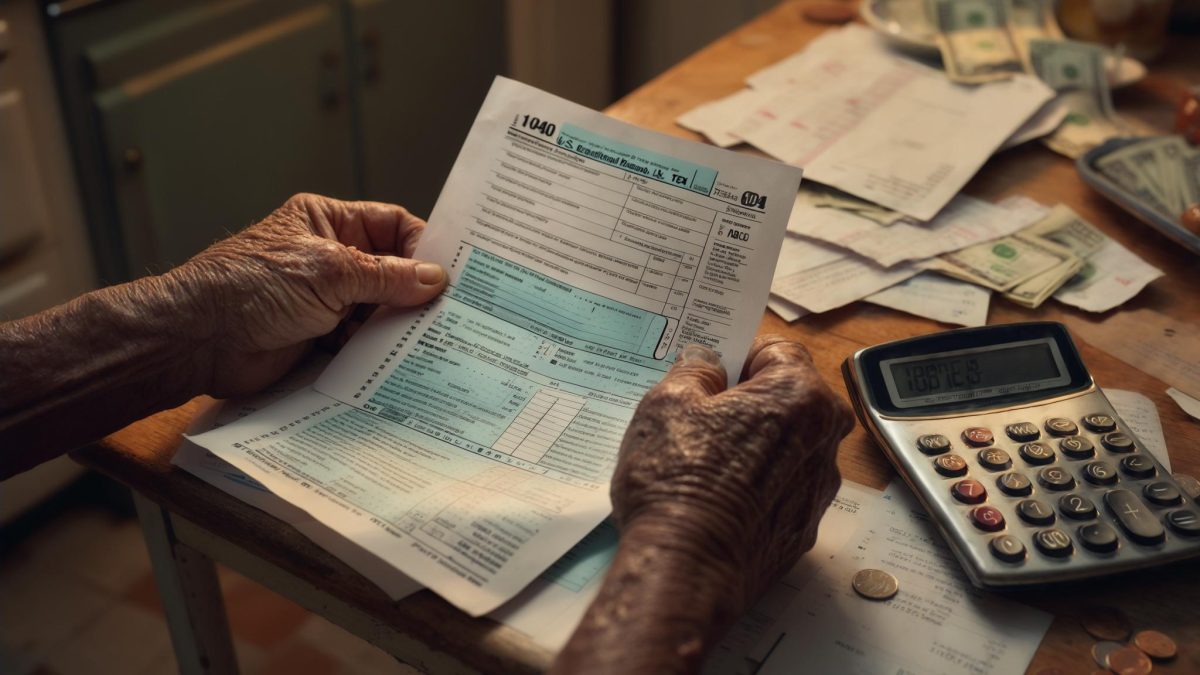
Roughly 16 million American workers receive income that fluctuates significantly from month to month, according to estimates from the JPMorgan Chase Institute — and a large share of them end up either underpaying or overpaying taxes each year without fully understanding why. For many, the bill arrives in April like a verdict they weren’t there to hear.
Travis Ingram heard his verdict in March of 2025. It was $4,100. He had twelve days to pay it or set up a plan with the IRS.
I was introduced to Travis through Pastor Darnell Webb at a Baptist church on the west side of San Antonio, where Travis had quietly asked for help understanding some paperwork he’d received from the IRS. Pastor Webb told me Travis had been carrying a financial weight that didn’t show up on his face — he described him as the kind of man who smiles wide at the kids’ soccer games and goes home to a dining room table covered in overdue statements. When I sat down with Travis Ingram at a diner near his apartment on a Thursday afternoon in late February 2026, he ordered coffee and kept his hands flat on the table, like he was steadying himself before he began.
The Income That Looked Good on Paper
Travis is 36 years old and has been in construction for thirteen years, the last four as a foreman for a mid-sized commercial contractor in the San Antonio metro area. On paper, the job sounds stable. In practice, it is anything but.
His base hourly rate is $29.50, but the actual hours he logs depend entirely on which contracts his employer has active. In a strong year — like 2022, when commercial building in South Texas was booming — Travis told me he cleared just over $74,000. In 2023, when two major projects were delayed and a third was cancelled outright, he brought home closer to $48,000. His W-2 looked different every January, and his withholding, which had been set based on a busier year, never caught up to reflect the leaner ones.
“Nobody ever explained to me that my W-4 wasn’t automatically adjusting,” Travis told me. “I thought the employer took out what you owed. I didn’t know I was supposed to be managing that myself.” He’d set up his withholding years earlier based on guidance from a coworker and hadn’t revisited it since his divorce in 2021.
That divorce reshuffled everything financially. Travis now pays $1,050 per month in child support for his two children, ages nine and eleven, who live with their mother about twenty minutes away. He sees them on weekends and pays for their activities out of pocket on top of the court-ordered support — soccer cleats, school supplies, a birthday party at a trampoline park in October that ran him $340 he didn’t quite have.
Where the Money Goes Before It Arrives
When Travis and I started going through his monthly expenses on a notepad, the math became uncomfortable quickly. His take-home on a typical month — around 40 hours a week, no major overtime — is approximately $3,900 after federal and Texas state withholding. Texas has no state income tax, which helps, but it doesn’t solve the federal problem.
- Child support: $1,050 per month, non-negotiable and non-deductible under current federal tax law
- Student loan payment: $387 per month on $31,400 remaining from a master’s degree in construction management he completed in 2018
- Rent: $1,140 per month for a one-bedroom apartment
- Monthly transfer to his mother in Corpus Christi: $450, sent via Zelle to help cover her medical co-pays and utilities
- Utilities, food, transportation: roughly $700–$900 depending on the month
That leaves Travis with somewhere between negative dollars and a thin cushion, depending on what unexpected bill shows up. “Most months I’m fine by the math,” he said, “but math and life aren’t the same thing.”
The student loans deserve their own chapter. Travis pursued his master’s degree believing it would move him into project management, a role that could add $20,000 or more annually to his income. He graduated in 2018, accepted a foreman promotion in 2019, and the pandemic effectively froze any further movement up the ladder. The degree cost him roughly $38,000; he’s paid down about $6,600 of that principal in eight years. He does claim the student loan interest deduction when he qualifies, but in high-income years, he phases out of it entirely — the deduction begins to phase out for single filers above $80,000 in modified adjusted gross income, according to IRS Publication 970.
The Winter That Broke the Budget
The tax bill wasn’t the only crisis. The winter of 2024–2025 was slow. Travis worked reduced hours from November through early February — the kind of seasonal slowdown that construction workers know to expect but never fully prepare for. His December paycheck was $1,870. His January check was $2,140. Child support still came out. The loan still came out. The rent still came out.
By mid-January 2025, Travis told me he had $114 in his checking account and four days until his next paycheck. He looked up whether he might qualify for SNAP benefits during that period.
He didn’t apply. Partly because he felt he earned too much in normal months to justify it, and partly, he admitted, because of pride. “My dad worked construction his whole life and never asked for a thing,” he said. “I know that’s not rational. But it’s there.”
Instead, he called his mother and told her he’d have to skip February’s transfer. She told him she’d figure it out. He told me that phone call was harder than any conversation he’d had with the IRS.
The $4,100 Bill and What Came Next
The tax bill arrived because 2024 had been a mixed year. Travis worked significant overtime in the spring and summer — his gross income for those six months alone was nearly $46,000. But his withholding was calibrated for a more modest annual salary, and no one had flagged to him that he was falling behind. When he filed in early March 2025, the number on the screen was $4,112.
Travis set up an IRS installment agreement, paying $342 per month over twelve months. That payment joined every other line item on his already-strained budget. He told me the agreement wasn’t hard to set up — he did it online in about twenty minutes — but the psychological weight of owing the federal government money on top of everything else was something he hadn’t anticipated.
“It felt like I failed at something I didn’t know was a test,” he said.
Where Things Stand Now
When I spoke with Travis in February 2026, he was eight months into his IRS payment plan with four months remaining. His 2025 taxes, filed through the VITA clinic in January, came back with a $610 refund — the first time in three years he hadn’t owed money at filing. He used $400 of it to replace a car part that had been rattling since October.
The family transfers to his mother in Corpus Christi have resumed at $300 a month, down from $450. His mother understood. His kids, now ten and twelve, don’t know any of this. Travis has made sure of that.
Travis told me he doesn’t regret the graduate degree, exactly. He regrets that no one in his program spent twenty minutes explaining what irregular income does to a tax return over time, or what happens to withholding after a divorce. He’d sat through entire semesters on project risk assessment. Nobody covered personal financial exposure.
“I can read a construction contract,” he said, finishing his coffee. “I can tell you the load-bearing specs on a commercial build. I had no idea I was slowly building a debt to the government every time I worked a good week.”
Pastor Webb, who introduced us, told me Travis had come to him not for prayer but for a pen and some privacy to fill out the IRS payment form at the church. That detail stayed with me. There is a specific kind of dignity in finding a quiet place to handle your problems. Travis Ingram has been doing exactly that — quietly, carefully, without complaint — for several years now. Whether the margin stays thin or finally opens up is something neither of us could predict when we shook hands goodbye in the parking lot that Thursday afternoon.
Related: She Worked 40 Years in Construction and Her First SS Check Was $1,340 — Now She Is Learning to Live With That Decision
Related: He Earned Good Money Battling Fires in Boise — Then the IRS Sent Him a $4,700 Bill He Never Saw Coming




Leave a Reply