
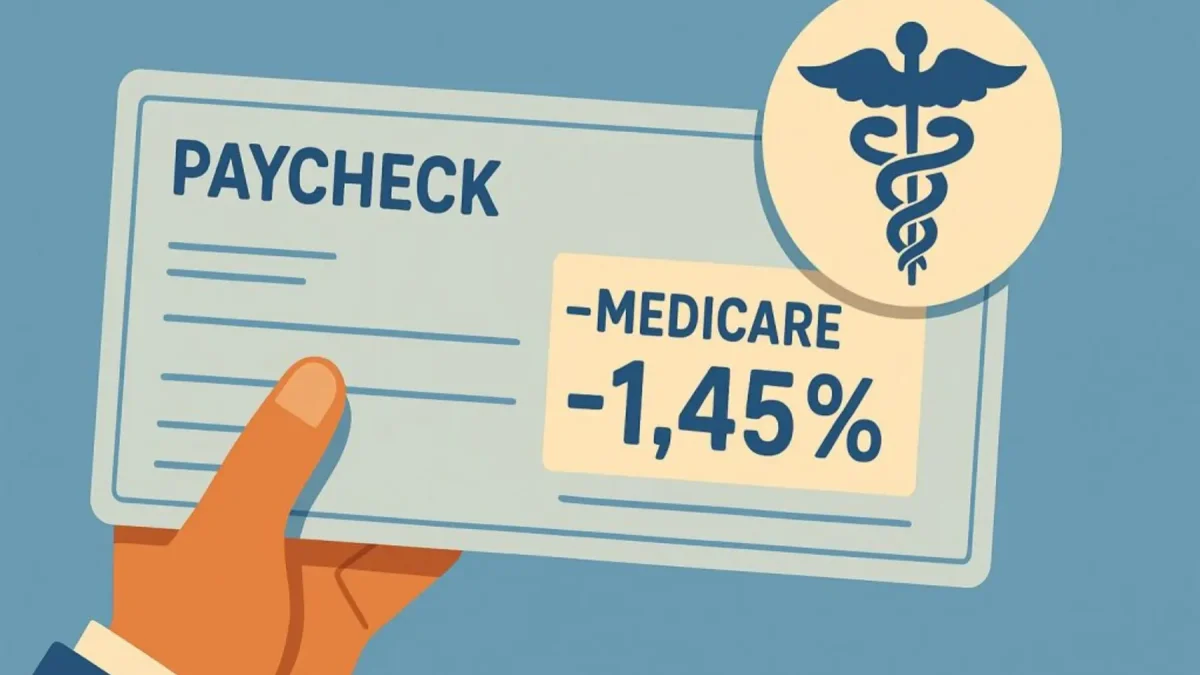
Every payday, you watch 1.45% of your wages disappear into Medicare taxes. Your employer matches that amount, sending a combined 2.9% to the IRS on your behalf. It’s automatic, invisible, and — you assume — completely reliable. But what happens when an employer withholds that money from your paycheck and simply never forwards it to the federal government? The answer is more common than most workers realize, and the consequences can blindside you decades later when you’re standing at the Medicare enrollment window expecting premium-free Part A coverage that you never actually earned.
How Medicare’s 40-Quarter Rule Determines Whether You Pay $0 or $505 Per Month
Medicare Part A — the hospital insurance portion — is premium-free for most Americans because they spent decades paying into the system. The threshold is 40 quarters of qualifying work, which translates to roughly 10 years of covered employment. Hit that number, and you pay nothing for Part A in retirement. Fall short, and the 2026 premium is $505 per month for those with fewer than 30 qualifying quarters, or $278 per month for those with 30 to 39 quarters.
That’s not a one-time fee. That’s $6,060 per year, every year, for the rest of your life — for coverage you believed you had already paid for through decades of paycheck deductions. For a retiree living on a fixed income, that distinction is financially devastating.
The Social Security Administration tracks your qualifying quarters using wage data reported by your employer to the IRS. If your employer withheld Medicare taxes from your paycheck but never remitted those funds or filed the corresponding payroll tax returns, the SSA has no record of your contributions. From the government’s perspective, those years of work may simply not exist.
The Payroll Tax Theft Scheme That Costs Workers Their Retirement Benefits
Payroll tax fraud is not a rare edge case. The IRS estimates that the annual “tax gap” — the difference between taxes owed and taxes actually paid — exceeds $600 billion, and unpaid employment taxes represent a significant portion of that figure. The IRS Criminal Investigation division pursues hundreds of payroll tax fraud cases each year, resulting in convictions, prison sentences, and asset seizures. But by the time federal prosecutors get involved, the damage to individual workers has often already been done.
The mechanics of the fraud are straightforward. An employer deducts Medicare and Social Security taxes from employee paychecks — those deductions appear on every pay stub, making employees believe the money is being properly handled. The employer is also legally required to match those contributions. But instead of remitting the combined amount to the IRS through the Electronic Federal Tax Payment System (EFTPS), the employer diverts the funds to cover operating expenses, personal debts, or simply pockets the money.
Small businesses under financial stress are disproportionately represented in payroll tax fraud cases, because employment taxes become an irresistible short-term cash source when cash flow tightens. The IRS calls this the “trust fund” problem — the withheld employee taxes are legally held in trust for the government, but unscrupulous employers treat them as a revolving line of credit they never intend to repay.
3 Warning Signs Your Employer May Not Be Forwarding Your Medicare Taxes
Most workers have no idea their employer is committing payroll tax fraud until the damage is done. But there are warning signs worth watching for, particularly if you work for a small or mid-size business:
Delayed or inconsistent pay stubs. Employers who are mishandling payroll taxes often have chaotic payroll administration overall. If your pay stubs arrive late, show inconsistent withholding amounts, or are difficult to obtain, that’s worth investigating.
IRS notices addressed to your employer. The IRS sends delinquency notices to employers who miss payroll tax deposits. If you ever see IRS correspondence at your workplace, or hear colleagues mention tax problems, take it seriously.
Your SSA earnings record shows gaps. This is the most reliable check. Your Social Security earnings record at SSA.gov should reflect wages for every year you worked. If a year shows zero or unusually low earnings despite full-time employment, your employer may not have filed the required Form 941 quarterly payroll tax returns.
What the IRS Can — and Cannot — Do to Protect Your Medicare Credits
Here’s where the situation becomes genuinely unfair for workers: the IRS has a legal mechanism called the “Trust Fund Recovery Penalty” that allows it to pursue individual business owners and officers personally for unpaid payroll taxes. The IRS can seize personal assets, garnish bank accounts, and file federal tax liens against responsible parties. In criminal cases, prison sentences of up to five years are possible under 26 U.S.C. § 7202.
But recovering those funds and crediting them to your Social Security earnings record are two separate processes that don’t automatically connect. Even if the IRS successfully collects from a fraudulent employer, the SSA may not automatically update your earnings record. You may need to proactively file a dispute with the SSA, provide documentation of your employment, and navigate a bureaucratic process that can take months.
The documentation you’ll need includes: W-2 forms from the years in question, pay stubs showing Medicare withholding, bank records showing direct deposits from the employer, employment contracts or offer letters, and any correspondence with the employer about compensation. The more paper evidence you can produce showing that you worked and that taxes were withheld, the stronger your SSA dispute will be.
How to Verify Your Medicare Earnings Credits Before You Turn 65
The single most important action any worker can take is to check their Social Security earnings record well before retirement — not at 64, but at 45, 50, and 55. The SSA allows you to create a free account at SSA.gov where you can view your complete earnings history going back to 1951. The record shows your reported wages for each year, which directly determines your qualifying quarters.
If you spot a discrepancy — a year of work that shows zero wages, or wages dramatically lower than what you actually earned — you have the right to file a correction request with the SSA. The process requires submitting Form SSA-7008 along with supporting documentation. The SSA generally has a three-year, three-month, and fifteen-day window to correct earnings records, though exceptions exist for fraud cases.
Catching a discrepancy at age 50 gives you 15 years to resolve it. Catching it at 64 gives you a matter of months before enrollment deadlines arrive — and as the FAQ section below explains, those deadlines do not pause while disputes are pending.
Reporting Employer Payroll Tax Fraud and the Financial Upside of Doing So
If you have reason to believe your employer is withholding Medicare taxes without remitting them to the IRS, you have several reporting options. IRS Form 3949-A, the Information Referral form, is the standard mechanism for reporting suspected tax fraud. You can submit it by mail or online through the IRS website.
For larger-scale fraud, the IRS Whistleblower Program is worth understanding. If the tax fraud you report results in the IRS collecting more than $2 million in taxes, penalties, and interest, you may be entitled to between 15% and 30% of the amount collected. For employees at companies where payroll tax fraud has been ongoing for years across a large workforce, the total underpayment can easily reach the qualifying threshold.
You should also consider filing a complaint with your state’s Department of Labor, which may have independent authority to investigate wage theft, and consulting an employment attorney who handles tax fraud cases. Many such attorneys work on contingency, meaning you pay nothing unless they recover money on your behalf.
More Stories Like This
- The Medicare Appeals Process That Reversed a $180,000 Surgery Denial Exists for Every Beneficiary — Most Patients Never Learn It’s an Option
- I’m 68, on Social Security, and Just Found Out I’ve Been Leaving $300/Month in Free Groceries on the Table (firstpersonfinance.com)
- She Missed Medicare Part B by 30 Days and Now Pays $2,000 Extra Every Year — Permanently, according to firstpersonfinance.com




Leave a Reply